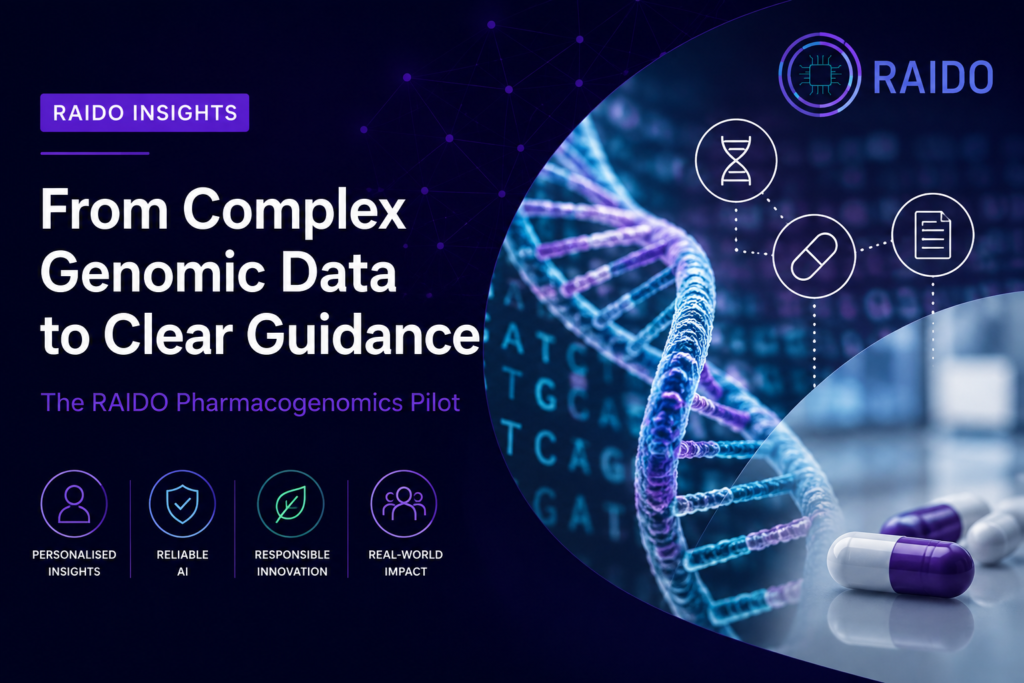
Medicines do not affect everyone in the same way. Genetic differences can influence whether a drug works as expected, whether a different dose may be needed, or whether a person is more likely to experience adverse effects. Pharmacogenomics, commonly known as PGx, uses this information to support safer and more personalised medication-related decisions.
However, applying PGx knowledge in practice remains challenging. Pharmacogenomics reports often contain complex genetic and clinical information that can be difficult to interpret and communicate consistently. Healthcare professionals may require detailed and technical explanations, while patients may benefit from simpler and more accessible summaries adapted to their level of understanding.
Within RAIDO Pilot 3, VITO and Jessa Hospital are exploring the development of an AI-powered PGx assistant. The work focuses on how artificial intelligence can help make complex pharmacogenomics information more accessible, understandable, and useful while addressing the reliability and transparency requirements of this sensitive domain.
The assistant is designed to transform complex gene–drug information into clear summaries tailored to different users. Rather than relying on unrestricted text generation, the proposed solution explores a controlled AI workflow in which generated content is grounded in validated PGx knowledge and checked against relevant source information. Guardrails and validation mechanisms are being investigated to help identify unsupported, incomplete, inconsistent, or potentially misleading outputs. Input from domain experts also helps keep the development aligned with professional practice and user needs. The prototype interface shown below illustrates how users can explore a sample patient profile, ask questions about pharmacogenomic findings, and receive structured information adapted to different user perspectives.
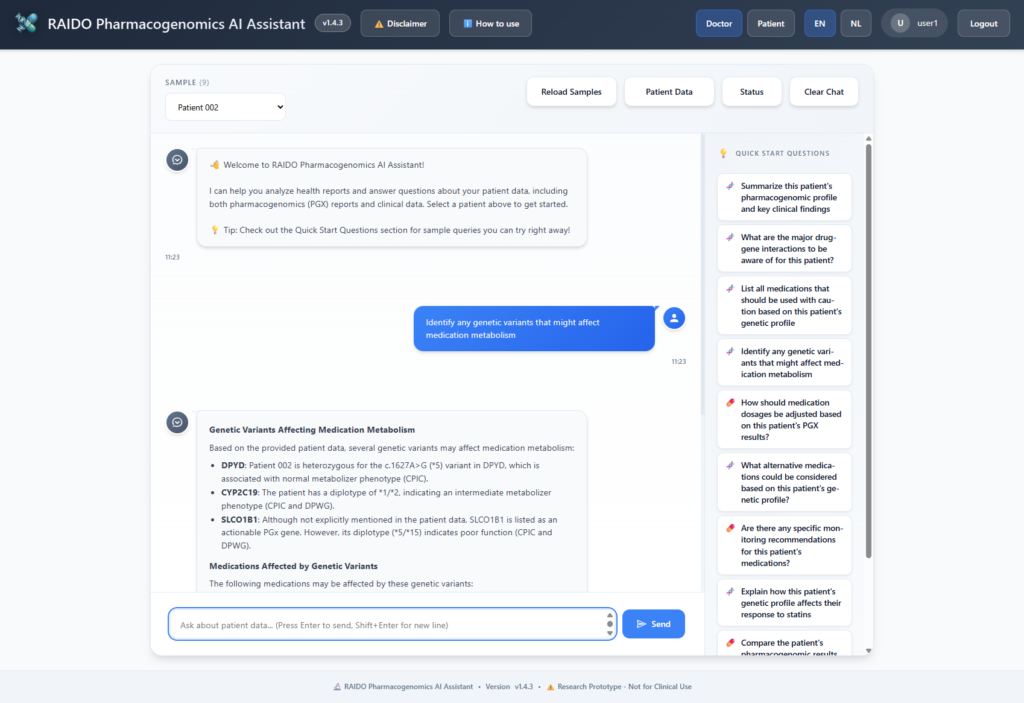
*The content shown is illustrative and does not reflect real individuals or clinical cases.
This direction is closely aligned with RAIDO’s broader goals for trustworthy and sustainable artificial intelligence. The PGx pilot provides a concrete research use case through which several aspects of responsible AI can be explored together using RAIDO capabilities. These include the use of synthetic data to complement limited datasets, the explainability and traceability of AI-generated information, the monitoring of AI workflows, and Green AI approaches aimed at assessing and reducing the energy footprint of the underlying models.
Through the PGx pilot, RAIDO provides a valuable framework for studying how trustworthy AI can be developed for complex and sensitive applications. The pilot reflects RAIDO’s broader ambition to move beyond technical performance and promote AI systems that are transparent, explainable, privacy-conscious, resource-aware, and designed to work alongside human experts.
Find us on Social Media