European research consistently pushes the frontiers of artificial intelligence, but transitioning complex deep learning architectures from academic prototypes into compliant, commercially viable products presents a formidable challenge. In the era of the EU AI Act and strict corporate sustainability targets, AI innovations must deliver both regulatory trust and measurable operational efficiency.
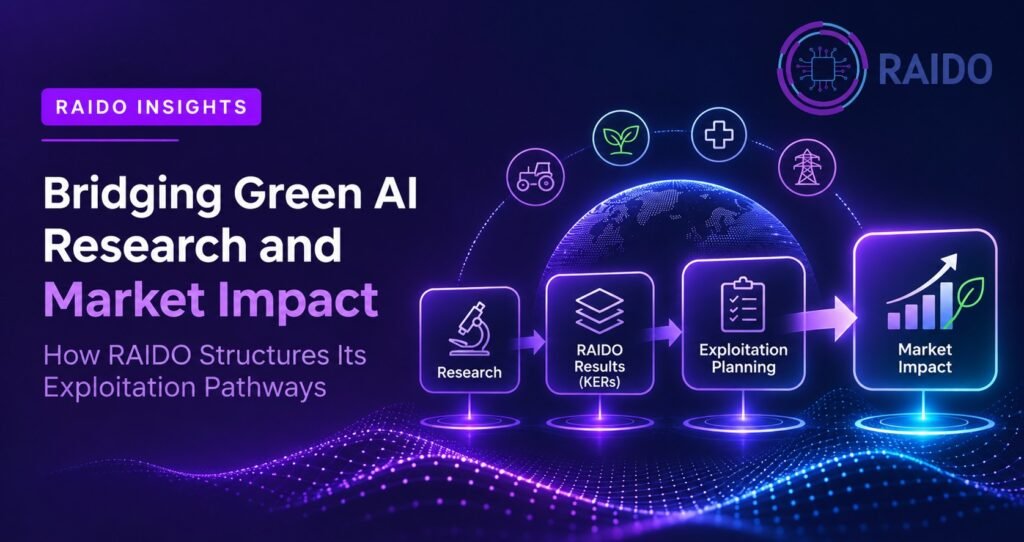
Within the RAIDO project, we initiated the exploitation process by mapping the individual Exploitable Results (ERs) across the consortium, systematically grounding them in our documented Background (BG) assets and newly generated Foreground (FG) technologies. Through dedicated cross-partner technical workshops, we performed a rigorous evaluation and prioritization exercise across all identified ERs. By assessing technology maturity and commercial feasibility, we consolidated the ERs into our six Key Exploitable Results (KERs).
The six KERs reflect RAIDO’s core technical pillars and overall vision:
- Automated Data Enrichment: KER 1, Data Enrichment and Distillation Software (DEDS), is an integrated software platform combining synthetic data generation (via Digital Twins and diffusion models), automated annotation, federated data mining, and model distillation. Managed by an intelligent orchestrator with built-in bias evaluation, DEDS aims to reduce data acquisition costs and compute overhead for rare or low-resource scenarios while supporting ethical AI practices.
- Data & Compute Efficient Models: KER 2, Toolbox for Optimized and Energy Efficient Training, brings together knowledge distillation, few- and zero-shot adaptation, and prompt tuning across unimodal and multimodal setups such as Vision-Language models. It reduces training costs and speeds up experimentation for resource-constrained teams.
- Green-AI & E2C Continuum Orchestration: This area brings together KER 3, RAIDO Green-AI Orchestrator, and KER 5, RAIDO Communication Layer. KER 3 dynamically manages hardware and software resources (CPU, RAM, GPU) to reduce energy waste and configure optimal training-inference pipelines. Supporting this, KER 5 serves as a robust, modular Data Lake storing diverse data types and metadata to enable efficient, low-overhead training across energy, farming, and healthcare verticals.
- Trustworthy AI, Governance & Explainability: This area covers KER 4, Blockchain-based AI Model Cards, and KER 6, Human-in-the-loop (HITL) Explainable AI (XAI) Optimization Platform. KER 4 issues non-transferable ERC-721 NFTs on Hyperledger Fabric to provide immutable, cryptographic proof of model metadata, ownership, and provenance. Complementing this governance, KER 6 provides intuitive insights into pre-processing and training pipelines, prompting expert user feedback (HITL) to iteratively optimize AI models with enhanced transparency and explainability.
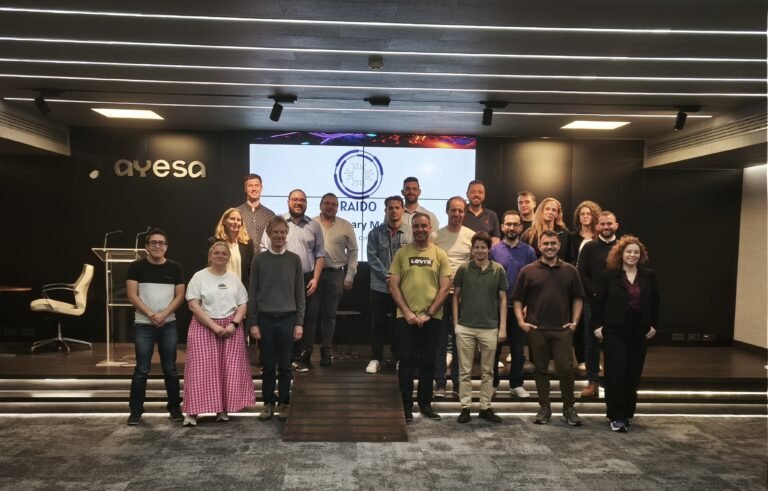
To support the future market uptake of these technical results, the consortium participated in a series of hands-on workshops guided by a business expert through the European Commission’s Horizon Results Booster (HRB). During these sessions, KER leaders used several business planning tools to assess the exploitation potential of each result:
- Unique Value Proposition (UVP) Canvas: Helped identify customer needs, challenges and expected benefits, and clarify the value that RAIDO’s results could offer to potential users.
- Lean Canvas: Supported the development of business models by identifying competitive advantages, distribution channels and potential B2B revenue streams, such as SaaS subscriptions and algorithm licensing.
- Market Definition Canvas and Strategic Business Plans: Helped identify potential early adopters and market opportunities in sectors such as smart agriculture, digital healthcare and energy utilities.
- Risk Assessments and Exploitation Roadmaps: Supported the identification of potential risks, intellectual property (IP) dependencies, ownership considerations and realistic Technology Readiness Level (TRL) progression paths towards future market uptake.
In this way, RAIDO provides a structured foundation for its partners to build on project results and explore future market and research opportunities beyond the project’s completion.
Find us on Social Media