
Bridging the gap between ethical intent and operational reality through transparent, trustworthy AI
As artificial intelligence systems are increasingly deployed in critical sectors—from energy grids to healthcare and robotics—relying on opaque, resource-heavy “black-box” models raises growing concerns. While establishing strong ethical guidelines is a vital first step, true trustworthiness demands technical visibility into how an AI actually arrives at its conclusions.
Clear explanations and justifications can help users better understand AI decisions and build trust in the systems they use. By making these complex systems more interpretable, human users are empowered to genuinely understand and trust the technology they use daily. To achieve this, the RAIDO project has developed a comprehensive, automated tool: the RAIDO eXplainable AI (XAI) Engine.
The Four Trust Levels
The RAIDO XAI Engine is designed to open the black box of AI models, making their behavior more transparent to end-users. It operates across four distinct Trust Levels to audit both structured tabular data and complex image datasets.

- Data Inspection: This initial checkpoint examines the fundamental trustworthiness of the raw data source. It performs a comprehensive automated audit to identify structural errors, missing values, duplicates, and potential privacy risks, such as Personally Identifiable Information (PII).
- Data Bias Detection: Before training begins, this module assesses the input data for representation bias. It analyzes the distribution of sensitive features to detect underrepresented groups, skewed data, and temporal distribution drift, helping identify potential biases before model training.
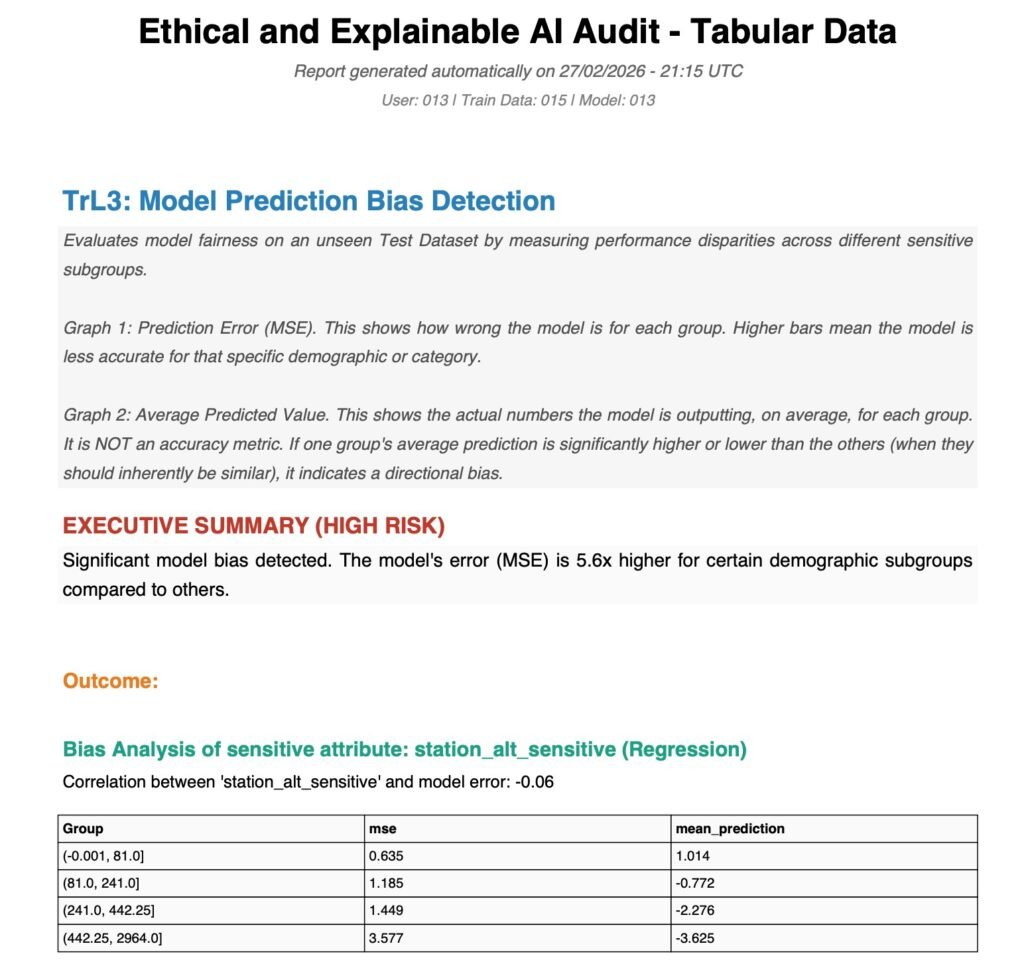
- Model Bias Detection: Operating strictly on unseen test data to prevent artificially optimistic results, this level evaluates algorithmic fairness. It measures whether the model performs consistently across different demographic subgroups or image classes, calculating critical metrics like equalized odds, predictive equality, and accuracy gaps.
- Explainability: The final level translates complex model decisions into human-interpretable insights. For tabular data, it leverages state-of-the-art tools like SHAP and LIME for global and local explanations. For images, it utilizes the RISE technique to generate visual saliency maps, overlaying heatmaps on original images to highlight the exact pixel regions that most heavily influenced the AI’s classification.
The outcomes of these analyses are presented in an automatically generated, easy-to-understand XAI report (see example below).
Beyond Understanding: Actionable Counterfactuals
One of the most powerful features of RAIDO’s approach to explainability is its emphasis on counterfactual explanations. Rather than requiring users to understand complex mathematical concepts, counterfactuals provide actionable “what-if” scenarios. The RAIDO platform adds clear sentences to the XAI report showing the minimal feature changes required to alter a specific prediction. This provides context and sheds light on the inner workings and “rationale” of machine-generated predictions.
Seamless Integration and Real-World Impact
To make these advanced tools accessible, the XAI Engine is built as a self-contained, containerized microservice within the RAIDO cluster. Instead of requiring users to write complex code, the framework is integrated into a lightweight, responsive frontend interface.
With a single click within the dashboard, users can trigger complex audits. Once the processing is completed in the background, the engine sends the comprehensive, easy-to-read XAI report directly to the Data Lake for immediate download.
By bringing greater transparency into the machine learning lifecycle, the RAIDO XAI Engine helps make AI solutions more understandable and accountable, while supporting regulatory compliance and human oversight.
Find us on Social Media