
Microrobotics enables applications that require working at very small scales. By combining high-precision positioning systems, sensors that can measure very small displacements and forces, and adapted control tools, it becomes possible to carry out localized and repeatable mechanical interactions. This makes microrobotics especially useful for applications such as manipulation, assembly, and the characterization of materials and objects at the microscale
At FEMTO-ST (UMLP), one of the applications studied in this context is the mechanical characterization of individual plant fibers, such as flax and hemp fibers. These materials are receiving growing attention for the development of bio-based composites because of their interesting specific mechanical properties and renewable origin. However, to use them efficiently, it is first necessary to understand their mechanical behavior at the individual-fiber scale.
Nettle tomography attached video – Caption: 3D reconstruction of a nettle fiber based on tomography
For this purpose, the required characterization process is particularly demanding. The fibers are very small, typically around three to four times thinner than a human hair, which makes it necessary to use small and carefully controlled forces and displacements. They also show strong natural variability related to their geometry, internal structure, origin, and growing or processing conditions. To address these challenges, microrobotics-based characterization platforms have been developed at FEMTO-ST. These include transverse compression tests using microforce sensors specifically developed for this application, together with high-precision positioning systems.
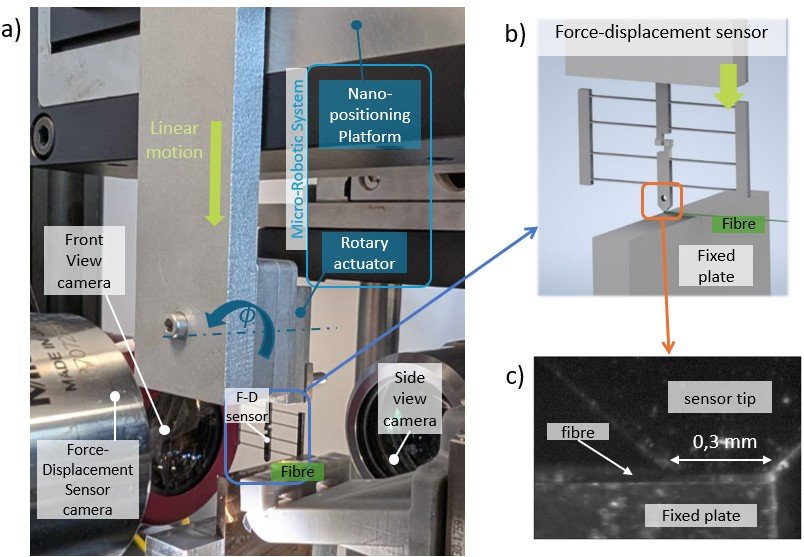
Fig. 1. a) Overview of the transverse compression experimental setup
b) Force-displacement sensor c) Real Fiber side view example
These systems make it possible to precisely control the test conditions. However, the platform and the related procedures are still relatively recent and continue to evolve. Preparing, positioning, and running each test takes time, while each experiment provides only a limited amount of information. In addition, the natural variability of the fibers means that many tests may be needed to obtain a representative description of their behavior.
It is precisely in this context that the RAIDO project provides an opportunity to explore how artificial intelligence can complement this microrobotic characterization approach. By integrating AI/ML models with both experimental and simulated data, we can study how well certain behaviors can be reproduced and whether this could gradually reduce the need for costly experimental or numerical processes in every new case.
To complement the limited experimental data, one of the directions explored within RAIDO uses synthetic data generated through finite element method (FEM) simulations. These simulations make it possible to study different parameters and conditions, but a single case still requires several hours of computation. Using these data, an AI-based surrogate model is being developed and evaluated to reproduce the behavior of the simulations within a few seconds, making it possible to explore new cases much more efficiently.
In parallel, work is also being carried out with the experimental data obtained from the microrobotic platform. These data are more limited and expensive to produce, and they also include the variability and noise found in real fibers. Here, the aim is to explore how AI can help to extract more information from the available data and develop models capable of strengthening and improving the efficiency of the experimental process, with the longer-term perspective of reducing the number of tests required to obtain reliable information.
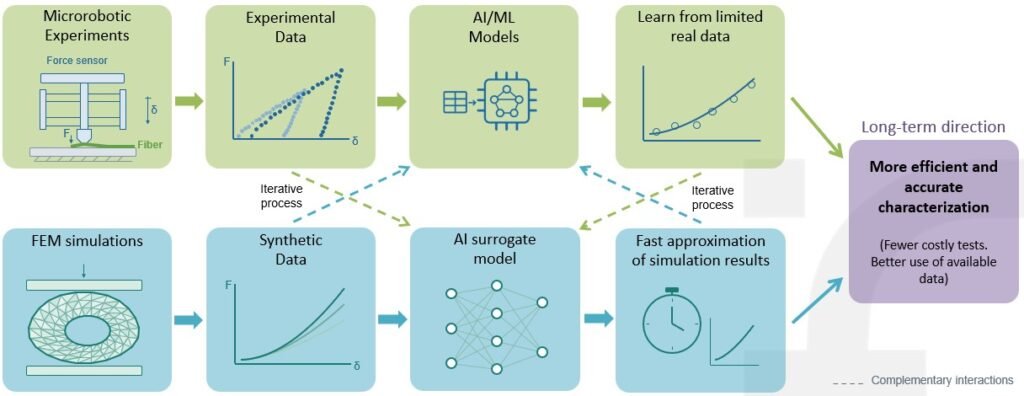
Fig. 2. Two parallel AI approaches in RAIDO: learning from microrobotic experiments and accelerating FEM simulations for more efficient plant-fiber characterization.
The characterization of plant fibers therefore provides a concrete case for studying the combination of microrobotics, modeling, and artificial intelligence. Although the current work focuses on this specific application, it may also help explore approaches that could be useful for other microrobotic processes where experimental data are slow, costly, or technically difficult to obtain. In this sense, RAIDO provides a framework for moving step by step toward experimental processes that are more efficient, more informative, and more intelligent.
Find us on Social Media