AI is becoming part of decisions that affect energy, healthcare, farming, robotics and industrial systems. But as AI becomes more powerful, one question becomes harder to ignore: how do we know what happened inside the AI optimisation process?
RAIDO addresses this challenge by combining Green AI, trustworthy AI and transparent monitoring into one coherent approach. Its aim is not only to build AI systems that perform well, but to make sure they are efficient, explainable, traceable and reliable throughout their lifecycle.
This is where blockchain plays an important role.
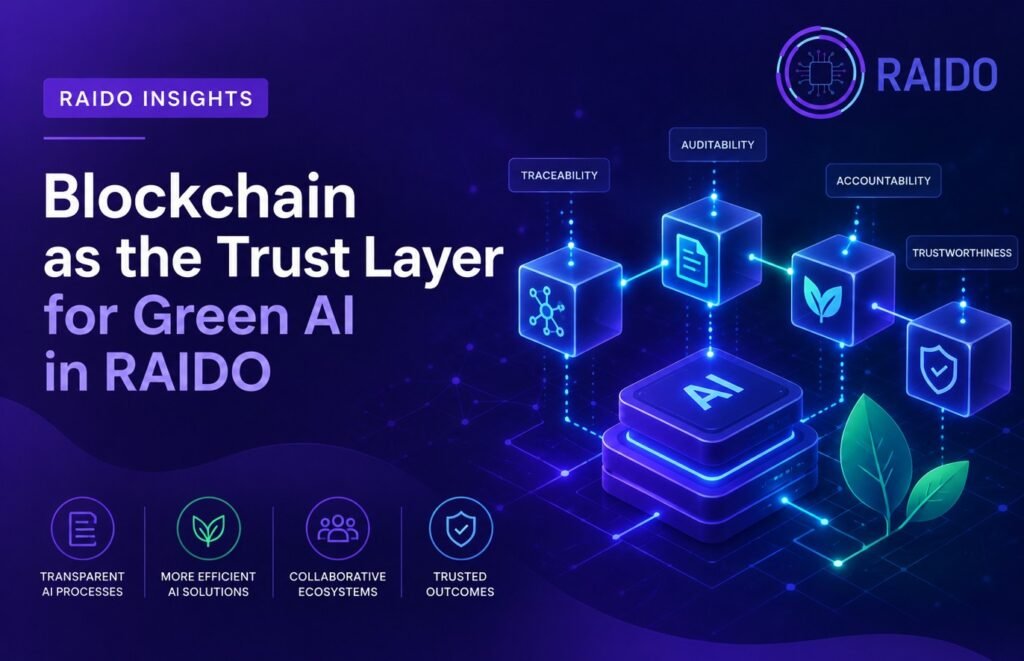
In RAIDO, blockchain acts as a trust layer around the Green AI Orchestrator. The orchestrator coordinates data, AI models, cloud resources, edge devices and optimisation workflows. Blockchain does not replace these systems. Instead, it records the important steps they take, creating a trustworthy audit trail of the AI optimisation process.
Think of it as a digital notary for AI workflows. When a model is created, improved, evaluated or validated, the blockchain component can record the key evidence: what happened, when it happened, who triggered it, what result was produced, and whether the expected criteria were met. This makes the process easier to inspect later and harder to manipulate silently.
The benefit is simple: AI optimisation becomes more transparent.
RAIDO also uses distributed storage alongside blockchain. Large files, reports, model evidence or detailed outputs do not need to be stored directly inside the blockchain. Instead, they can be stored separately, while blockchain keeps a secure reference to them. This keeps the system lighter and more practical, while still preserving proof that the evidence exists and has not been changed unnoticed.
This approach is especially useful for Green AI. Energy-efficient AI is not only about reducing computation. It is also about choosing better workflows, avoiding unnecessary retraining, improving reuse, and understanding which optimisation steps actually helped. By keeping a clear record of these steps, RAIDO can support more accountable decisions about how AI models are trained, improved and deployed.
The blockchain component also strengthens trust between organisations. RAIDO is built around collaboration, and collaborative AI ecosystems need shared confidence. A single central log is often not enough when multiple actors are involved. A shared, permissioned blockchain can help participating organisations rely on the same record of events, while still keeping access controlled.
In practical terms, the blockchain layer supports four important qualities:
- Auditability, because important actions are recorded.
- Traceability, because AI workflows can be followed over time.
- Accountability, because actions can be linked to responsible actors or systems.
- Trustworthiness, because records become harder to alter without detection.
RAIDO’s use of blockchain is therefore not about hype or cryptocurrency. It is about making AI development more transparent, governed and reliable. It gives the Green AI Orchestrator a memory: a structured, trustworthy record of how data, models and optimisation decisions evolved.
As AI systems become more embedded in critical domains, this kind of trust layer will become increasingly important. RAIDO shows how blockchain can support that future: not as the centre of the AI system, but as the mechanism that helps prove the system behaved as intended.
Find us on Social Media