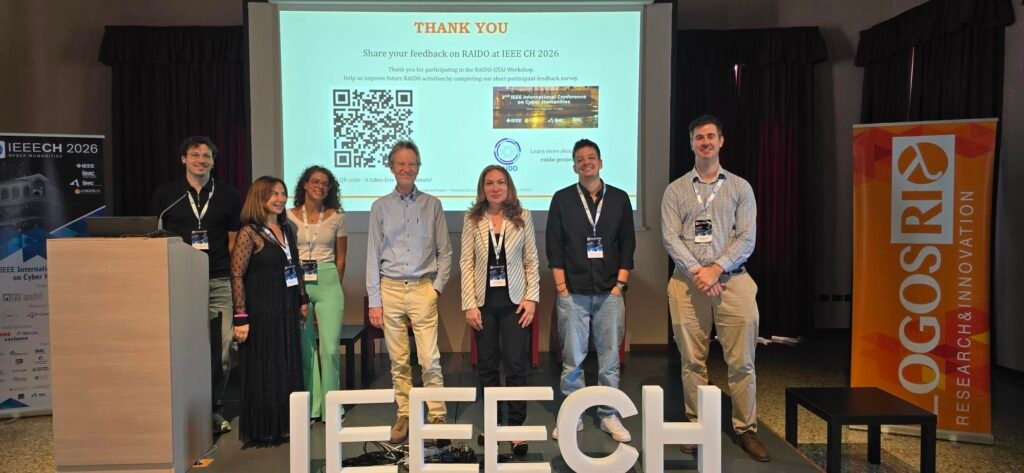
The RAIDO project participated in the 2nd IEEE International Conference on Cyber Humanities (IEEE CH 2026), held in Venice, Italy, from 7 to 9 September 2026, supporting a dedicated workshop on Green and Trustworthy Artificial Intelligence for Digital Humanities and Cultural Heritage.
The 2nd IEEE CH Workshop on Green Trustworthy AI for Digital Humanities and Cultural Heritage (RAIDO-GTAI) provided a dedicated setting for presenting research on how trustworthy, sustainable and data-efficient AI approaches can support Digital Humanities and Cultural Heritage applications.
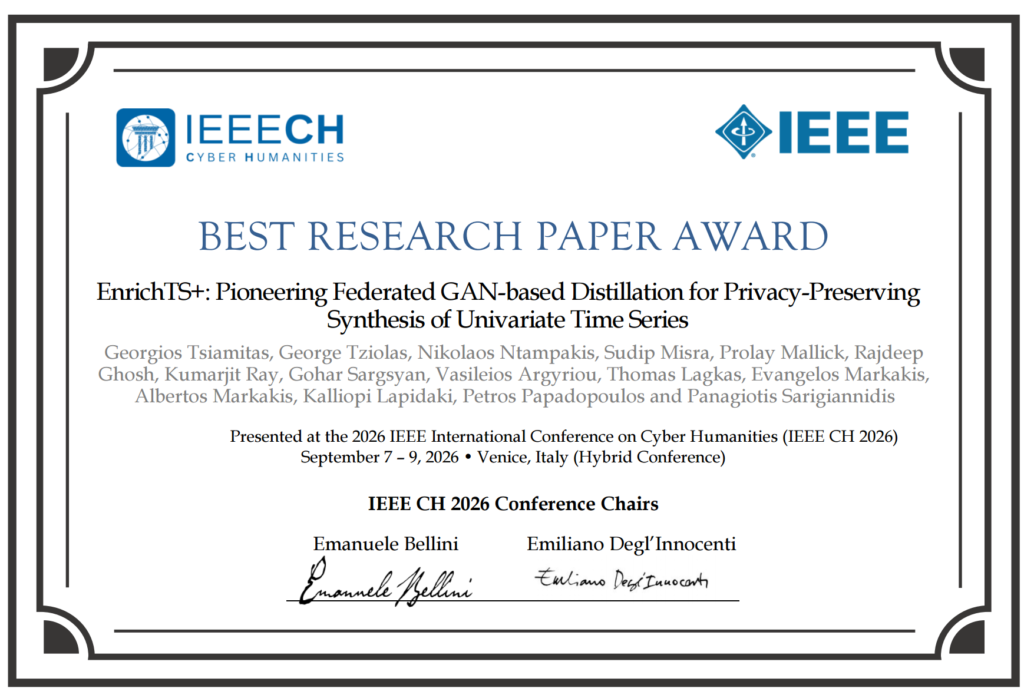
RAIDO research featured prominently in the workshop through three research contributions, addressing privacy-preserving synthetic data generation, federated continual learning, and transparency and interoperability in AI workflows. A key highlight of the project’s presence at IEEE CH 2026 was the recognition of the EnrichTS+ research with the Best Research Paper Award.
Privacy-Preserving Synthetic Data for Cultural Heritage
The paper “EnrichTS+: Pioneering Federated GAN-based Distillation for Privacy-Preserving Synthesis of Univariate Time Series” presented a new approach for generating useful synthetic time-series data while keeping original measurements local.
EnrichTS+ combines federated learning and generative AI to enable multiple data sources to contribute to a shared learning process without exchanging their raw data. Knowledge from the resulting model is then transferred into a synthetic dataset that can be shared and reused for further AI development.
The approach was evaluated in a cultural heritage monitoring setting, using relative humidity data from two different deployments. The results showed that the synthetic data retained important temporal characteristics of the original datasets while enabling downstream forecasting without access to the original measurements.
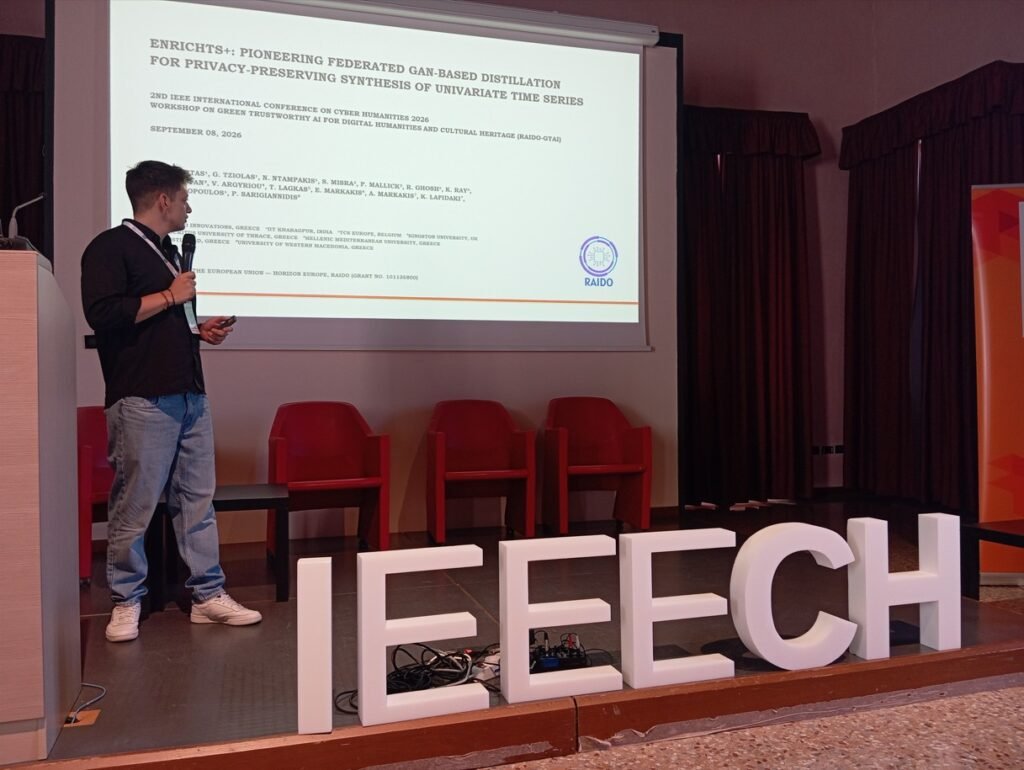
The research was also showcased through an end-to-end demonstration of the EnrichTS+ pipeline, covering federated teacher training, GAN-based distillation, synthetic humidity-series generation and independent evaluation.
EnrichTS+ Receives the Best Research Paper Award
The EnrichTS+ contribution was recognised with the Best Research Paper Award at IEEE CH 2026, marking an important achievement for the research carried out within RAIDO.
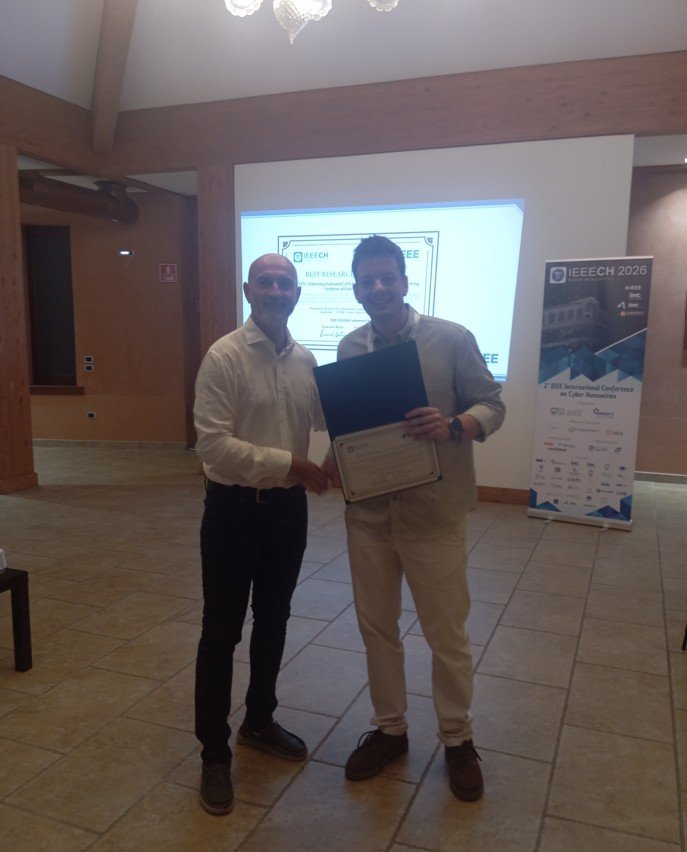
The work addresses a central challenge for Trustworthy AI: enabling organisations to benefit from distributed data while reducing the need to exchange the original information. The EnrichTS+ paper explicitly acknowledges support through the RAIDO project under Horizon Europe Grant Agreement No. 101135800.
Continuous and Efficient Learning from Distributed Cultural Heritage Data
The second contribution, “An Inclusive and Lightweight Approach to Federated Continual Learning for Cultural Heritage,” focused on another challenge faced by AI systems: how models can continue learning as new data become available across different organisations or locations, without requiring those data to be centrally collected.
The research proposed FedCurv-DR, a lightweight Federated Continual Learning approach designed to mitigate catastrophic forgetting while keeping data local. Using cultural heritage image data, the study examined model performance alongside energy consumption and differences in performance across participating clients.
The results illustrate the trade-offs involved in developing AI systems that need to continuously adapt while also considering computational efficiency and balanced performance across distributed participants – aspects closely connected to RAIDO’s work on Green and Trustworthy AI.
Improving Transparency and Interoperability of AI Workflows
The third paper, “Automated Extraction of MPAI-AIF Metadata from Workflow Diagrams Using Computer Vision and OCR,” addressed the challenge of turning visual AI workflow diagrams into structured, machine-readable information.
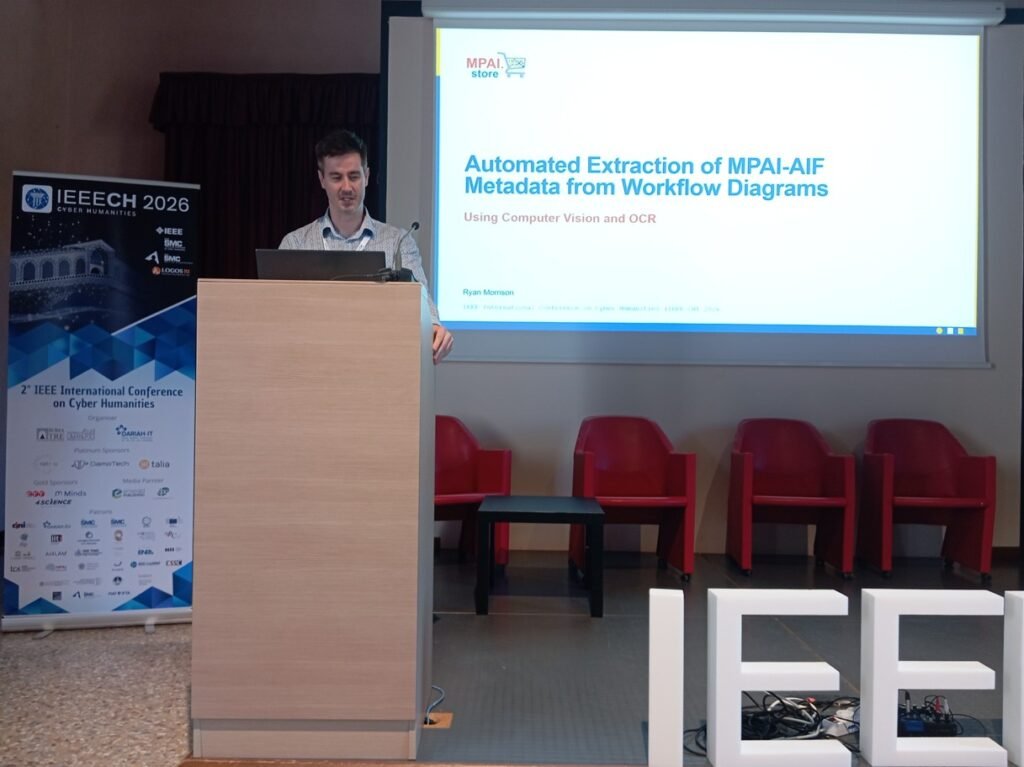
The research presented an open-source Python tool that combines computer vision and Optical Character Recognition (OCR) to identify components and connections in workflow diagrams and generate metadata scaffolds compliant with the MPAI-AIF V2 specification. The tool was evaluated on 124 workflow diagrams from MPAI standards relevant to Cyber Humanities.
By supporting more automated and structured documentation of AI workflows, the work contributes to transparency, explainability and interoperability – important elements of the RAIDO approach to Trustworthy AI. The standardisation activity described in the paper was carried out within the RAIDO project.
Bringing Green and Trustworthy AI to Digital Humanities and Cultural Heritage
Together, the three contributions presented at IEEE CH 2026 highlight different dimensions of RAIDO’s research: protecting data while enabling its reuse, supporting continuous and resource-aware learning, and improving the transparency and interoperability of AI systems.
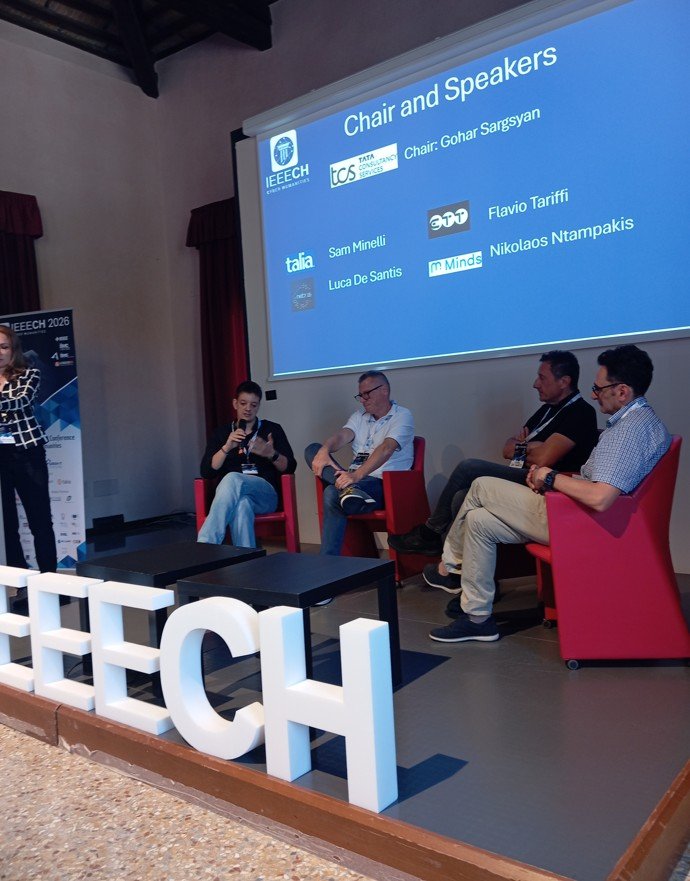
Through the RAIDO-GTAI Workshop, these developments were brought into the context of Digital Humanities and Cultural Heritage, demonstrating how Green and Trustworthy AI research can address challenges related to distributed data, privacy, efficiency and transparent AI processes.
The Best Research Paper Award for EnrichTS+ provided further recognition of the research being developed within the project and its application to emerging challenges at the intersection of Artificial Intelligence and Cultural Heritage.
As RAIDO progresses through its final year, the project continues to develop and validate approaches for more efficient, transparent and trustworthy AI, connecting research advances with practical applications across different domains.
About RAIDO
RAIDO is a Horizon Europe-funded research and innovation project focused on advancing Trustworthy and Green AI through an integrated framework covering data management, model optimisation, explainability, and sustainable AI deployment. The project develops innovative methods for automated data curation and enrichment, including Digital Twins and diffusion models, alongside data- and compute-efficient AI techniques such as few-/zero-shot learning, continual learning, and model distillation. RAIDO further integrates explainability, blockchain-enabled traceability, reinforcement learning, and AI orchestration mechanisms to support transparent, accountable, and energy-efficient AI systems across cloud-edge environments. The platform is being validated through four real-world demonstrators in application domains including smart grids, smart farming, healthcare, and robotics.
RAIDO project has received funding under the European Union’s Horizon Europe research and innovation programme under Grant Agreement No 101135800. UK participants in Horizon Europe Project Raido are supported by UKRI.

Download the press release here: RAIDO Showcases Green and Trustworthy AI Research at IEEE CH 2026
Find us on Social Media