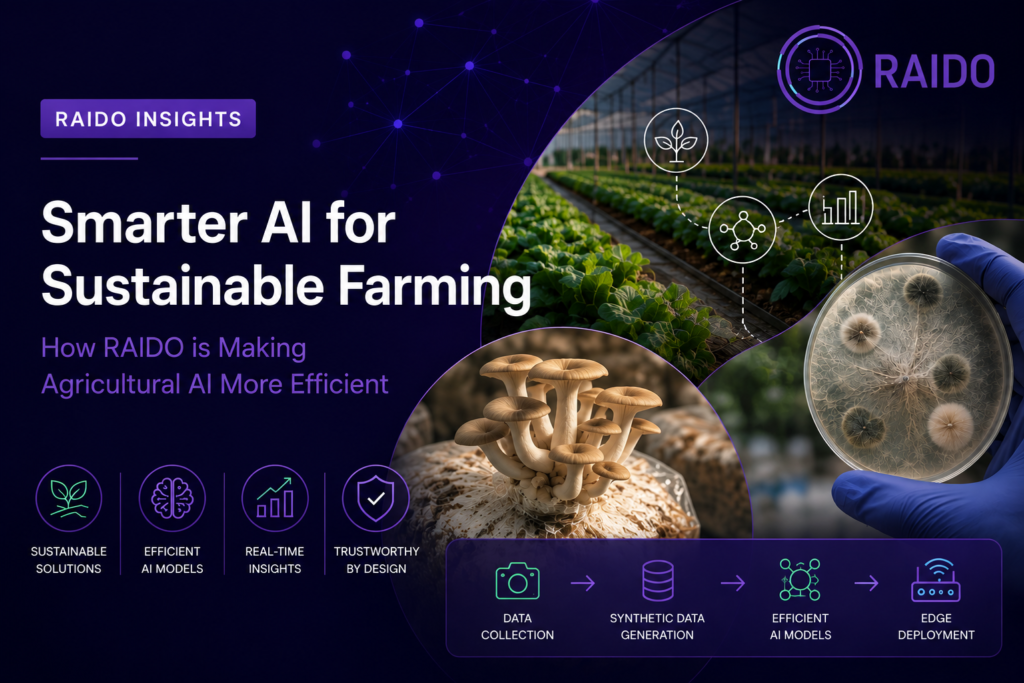
Artificial Intelligence has the potential to transform agriculture and food production. From monitoring crop health to optimizing fungal cultivation for alternative protein production, AI can help producers make faster, more informed decisions while reducing waste and improving sustainability.
However, building reliable AI systems for agriculture comes with significant challenges.
High-performing AI models typically require vast amounts of labelled data and substantial computing power. Collecting high-quality images and environmental measurements is often expensive and time-consuming, while running large AI models continuously can consume considerable energy—especially when deployed on edge devices in greenhouses or production facilities.
Within the RAIDO project, we are addressing these challenges by developing AI technologies that are not only accurate but also resource-efficient.
One of RAIDO’s Smart Farming pilots focuses on fungal-based food production. The pilot investigates how advanced AI can detect contamination during cultivation by combining image analysis with synthetic data generation and energy-efficient model optimisation.
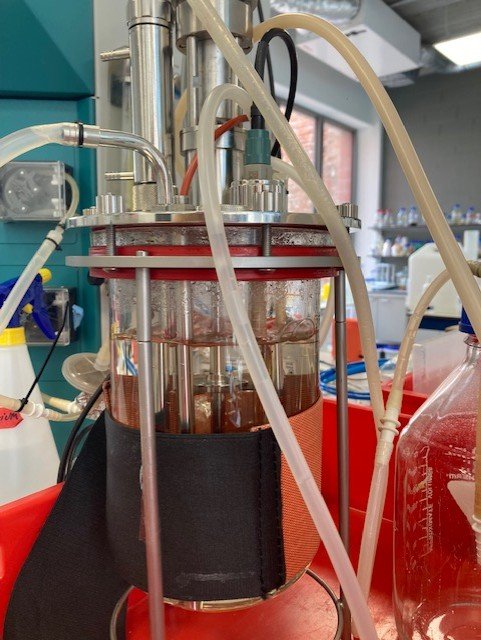
Figure 1: Fungal cultivation setup used in the RAIDO Smart Farming pilot
Instead of relying solely on large collections of manually labelled images, RAIDO leverages synthetic data generation to expand limited datasets. Artificially generated yet realistic images allow AI models to learn from a broader range of scenarios while reducing the need for costly manual data collection. This makes it possible to develop robust AI solutions even when only a limited amount of real-world data is available.
At the same time, RAIDO applies model compression and knowledge distillation techniques to create smaller, more efficient AI models. These compressed models maintain high predictive performance while requiring significantly less computational power, making them suitable for deployment on resource-constrained edge devices directly within agricultural environments.
The result is an AI workflow that is both scalable and sustainable.
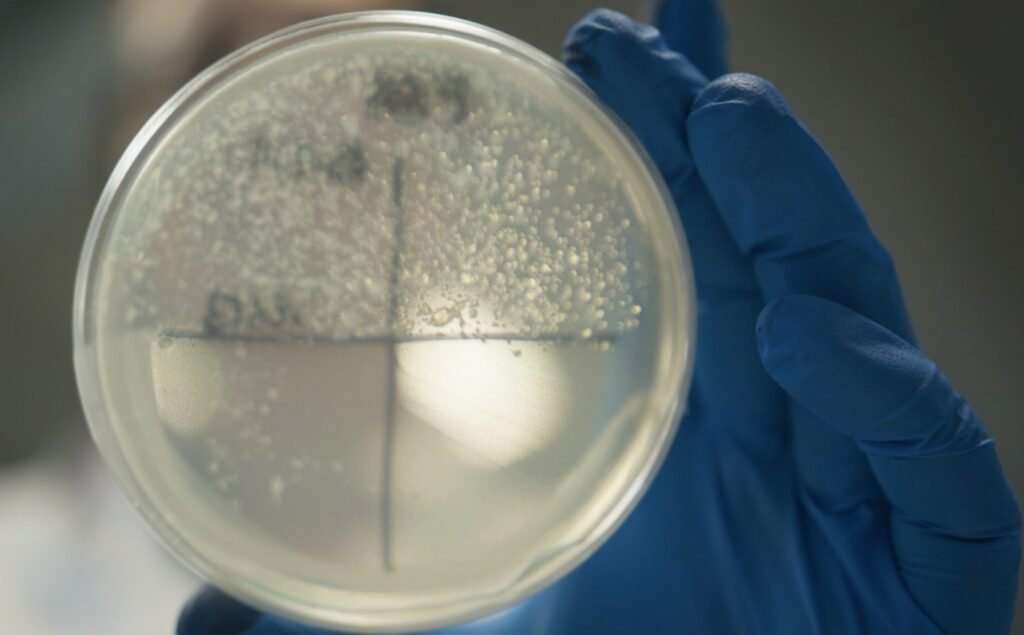
Figure 2: Fungal sample used for contamination detection in the RAIDO Smart Farming pilot
For farmers and food producers, this means faster detection of contamination or cultivation issues, lower operational costs, and improved decision-making based on real-time insights. By reducing both data collection efforts and energy consumption, RAIDO contributes to more sustainable agricultural practices without compromising AI performance.
Beyond this specific pilot, the technologies developed within RAIDO demonstrate how trustworthy and energy-efficient AI can support the broader digital transformation of agriculture. As food production faces increasing demands for efficiency, sustainability, and resilience, solutions that combine advanced machine learning with practical deployment become increasingly important.
RAIDO is helping pave the way towards AI systems that are not only intelligent but also accessible, scalable, and environmentally responsible—bringing the future of smart farming one step closer.
Find us on Social Media