When we talk about trustworthy artificial intelligence (AI), conversations often focus on making AI systems more transparent or explainable. But before we can explain how an AI system reaches its decisions, we first need to ensure it has been built on a strong ethical foundation.
This is the principle behind ethics-by-design (Nurock et al., 2021): the idea that ethical considerations should be embedded throughout the entire AI lifecycle rather than added as an afterthought. Instead of asking whether a finished system is ethical, ethics-by-design encourages developers, researchers, and stakeholders to consider questions of fairness, privacy, accountability, transparency, and human well-being from the very beginning.
Within the RAIDO project, this philosophy has become a central part of the work. Rather than treating ethics as a one-time checklist, we view it as an ongoing process that evolves alongside the technology itself. Our work draws on the ethics-by-design framework proposed by Vanessa Nurock and colleagues, as well as guidance developed for the European research community on responsible AI development. One of the key ways we have put these principles into practice is through the creation of the RAIDO Ethics Helpdesk.
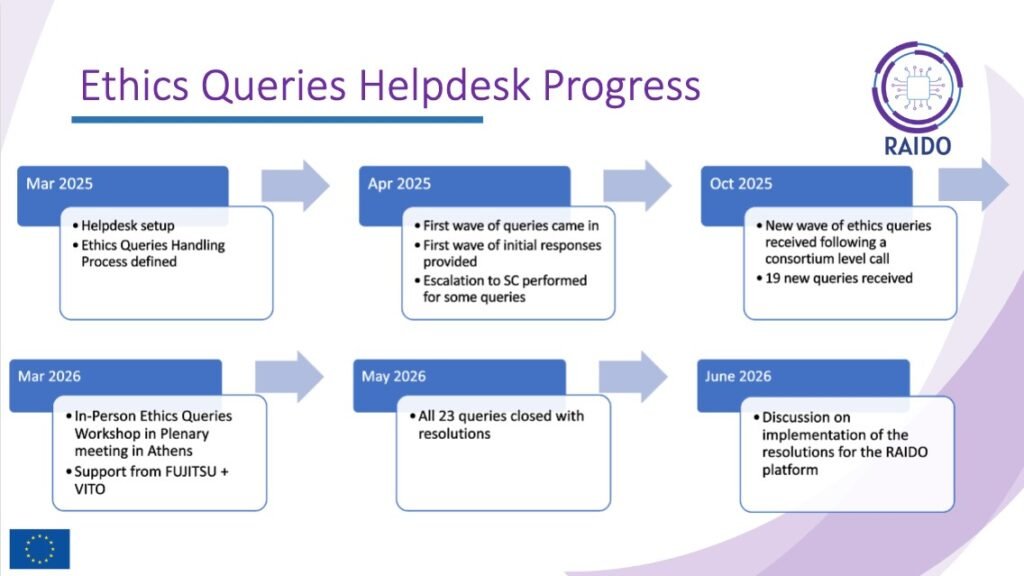
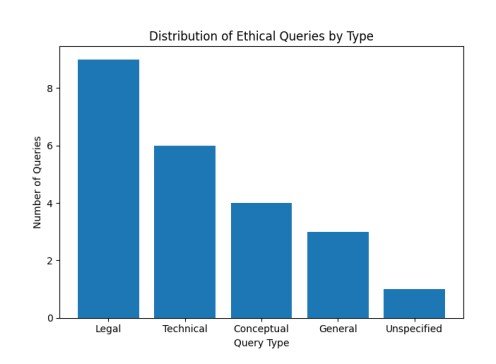
The Ethics Helpdesk provides a dedicated route for consortium members to raise ethical questions as they emerge during the design, development, and pilot phases of the project. Every query is documented in a central Ethical Queries Log, creating a transparent record of concerns, discussions, and resolutions. Depending on the nature of the issue, queries may involve technical experts, legal specialists, or external ethics advisors, ensuring that responses reflect a range of perspectives.
Importantly, the Helpdesk is designed to encourage dialogue rather than simply provide definitive answers. Some ethical questions-particularly those surrounding accountability, responsibility, or emerging regulations-do not have straightforward solutions. Instead, they require ongoing discussion as technologies, policies, and societal expectations continue to evolve.
The system has also evolved throughout the project. After an initial round of ethical queries, feedback highlighted the need for greater engagement across the consortium. A project-wide call for submissions led to a substantial increase in participation, generating discussions on topics such as AI transparency, bias, data governance, explainability, and societal impact. During a workshop held at the project’s plenary meeting in Athens, researchers, technical partners, legal experts, and ethics specialists worked together to explore these challenges and identify practical solutions.
These discussions have already influenced the project in meaningful ways. Several queries resulted in recommendations to strengthen explainability features, incorporate confidence indicators, improve governance structures, and reinforce human oversight within the platform. Even when a query did not require immediate technical changes, documenting the discussion created a valuable knowledge base for future development.
Ultimately, ethical AI cannot be achieved through technical innovation alone. It requires continuous reflection, collaboration, and a willingness to engage with difficult questions throughout the development process. By embedding ethics into everyday project activities, initiatives such as the RAIDO Ethics Helpdesk help ensure that AI systems are not only innovative and effective, but also responsible, trustworthy, and aligned with the values of the people they are designed to serve.
References
Dainow, B., & Brey, P. (2021). Ethics by Design and Ethics of Use Approaches for Artificial Intelligence (Version 1.0). European Commission DG Research & Innovation. https://ec.europa.eu/info/funding-tenders/opportunities/docs/2021-2027/horizon/guidance/ethics-by-design-and-ethics-of-use-approaches-for-artificial-intelligence_he_en.pdf
Nurock, V., Chatila, R., & Parizeau, M. H. (2021). What does “ethical by design” mean? In Reflections on Artificial Intelligence for Humanity (pp. 171–190). Springer. https://doi.org/10.1007/978-3-030-69128-8_1
Find us on Social Media