As the EU AI Act moves from legislation to enforcement, one of its most operationally demanding requirements sits in Article 10 data and data governance. For high-risk AI systems, it is no longer enough to collect data and train a model. Providers must demonstrate that their datasets were examined earlier for bias, that sensitive demographic attributes were accounted for, and that statistical representativeness was actively verified. RAIDO addresses this requirement head-on through the bias detection module.
The Problem with Imbalanced Datasets
Real-world datasets are rarely balanced. Historical data reflecting societal inequalities in hiring, lending, healthcare, criminal justice tends to over-represent certain groups while marginalizing others. When an AI model trains on such data, it doesn’t just learn patterns, it also learns and amplifies those imbalances. A model trained predominantly on data from one demographic group will perform poorly, or worse, discriminatorily, when deployed on others. This is not a hypothetical concern; it is a documented failure mode of AI systems operating at scale.
Detecting this early, before a model is trained or deployed, is precisely what Article 10 demands. Specifically, Article 10(2)(f) requires bias examination against sensitive attributes, and Article 10(2)(g) addresses to take appropriate measures for mitigating the bias. Article 10(3) also mandates that datasets carry appropriate statistical properties with respect to the persons or groups the system is intended to serve.
Our Approach: Composite Balance Scoring
Bias detection module evaluates datasets against user-defined sensitive attributes using a composite balance score. Rather than applying a single metric, the score aggregates multiple fairness indicators to produce a holistic assessment of whether dataset is skewed toward a particular category. CBS is a measure of balance for protected (sensitive) attributes adapted to multi-class protected attributes and intersectional fairness and demonstrates its correlation with model bias. CBS is evaluated for each protected attribute using three metrics: the Balance Index, the RMSDIR, the RMSPMI. The output is clear and actionable; the dataset is flagged as biased or fair based on CBS score, with attribute-level granularity. CBS(A) = 1 means that the attribute is perfectly balanced. This directly operationalizes Article 10(2)(f).
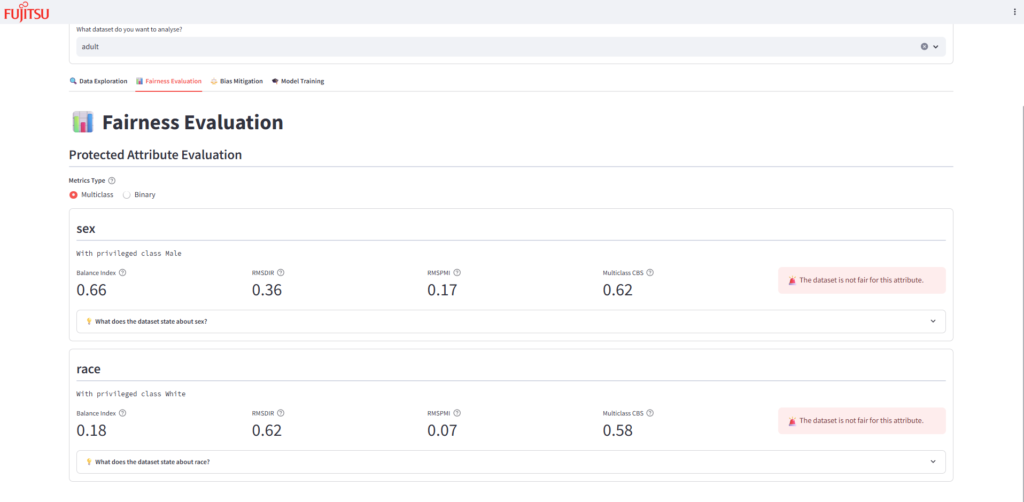
Figure 1: Fairness Analysis result on “adult” dataset from UCI repository
From Detection to Mitigation
Detection alone is necessary, but not sufficient. Article 10(2)(g) requires that identified biases are also addressed. The same internal framework extends into bias mitigation through a resampling-based approach, explored in the paper Fairbeat: Assessing and Mitigating Bias with the Composite Balance Score(https://dl.acm.org/doi/10.1007/978-3-032-06129-4_34). The approach goes beyond standard techniques by introducing five distinct balancing strategies, including Complete Balance, a novel combination of class and label balancing, and by handling intersectional attributes, meaning multiple protected attributes such as gender and race can be balanced simultaneously rather than in isolation. This is a meaningful technical advance over prior fairness literature, which largely treats protected attributes independently.
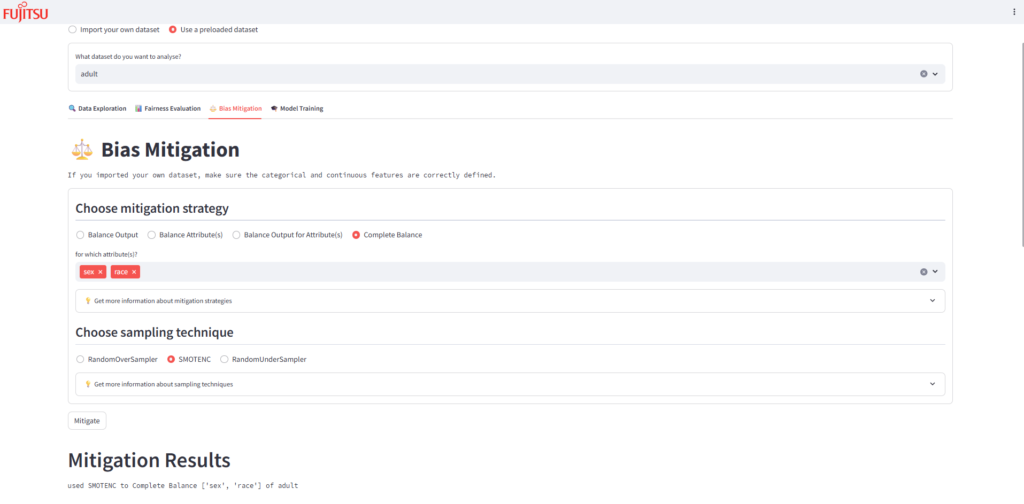
Figure 2: Bias Mitigation input method selection
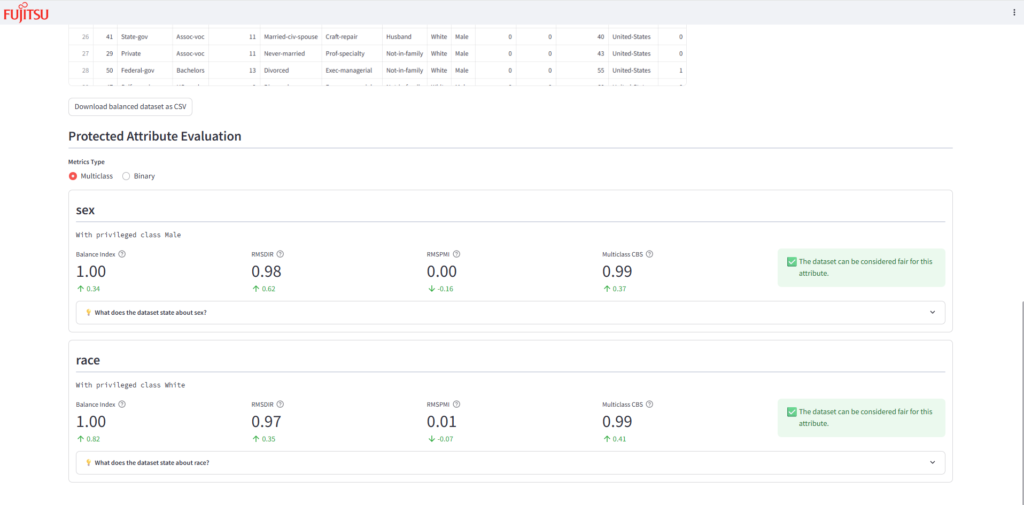
Figure 3: Fairness Evaluation result after mitigation (on adult dataset)
Where This Sits in the AI Act
It is worth being precise about the scope. The bias detection module is not, on its own, a compliance solution for the AI Act. It provides a concrete, reproducible mechanism for satisfying the data governance obligations that sits at the foundation of any high-risk AI system’s compliance posture.
The module’s output also feeds naturally into Article 9 risk management processes. A documented fairness assessment is a meaningful input to any risk register, and supports the transparency requirements of Article 13, where providers must disclose relevant information about training data characteristics.
From Checkbox to Culture
Compliance with the AI Act should not be treated as a documentation exercise. The value of tooling like RAIDO’s bias detection module is not just that it produces an output that regulators can inspect, it is that it embeds fairness verification into development workflow itself. Teams are prompted to think about sensitive attributes before training begins, not after a model has already learned from the biased data.
As enforcement deadlines approach, the gap between organizations that have operationalized these checks and those that have not will become consequential. RAIDO demonstrates that for research and development projects working with real-world data, systematic fairness assessment is not only achievable, but also a natural part of building AI systems that can be trusted.
Find us on Social Media