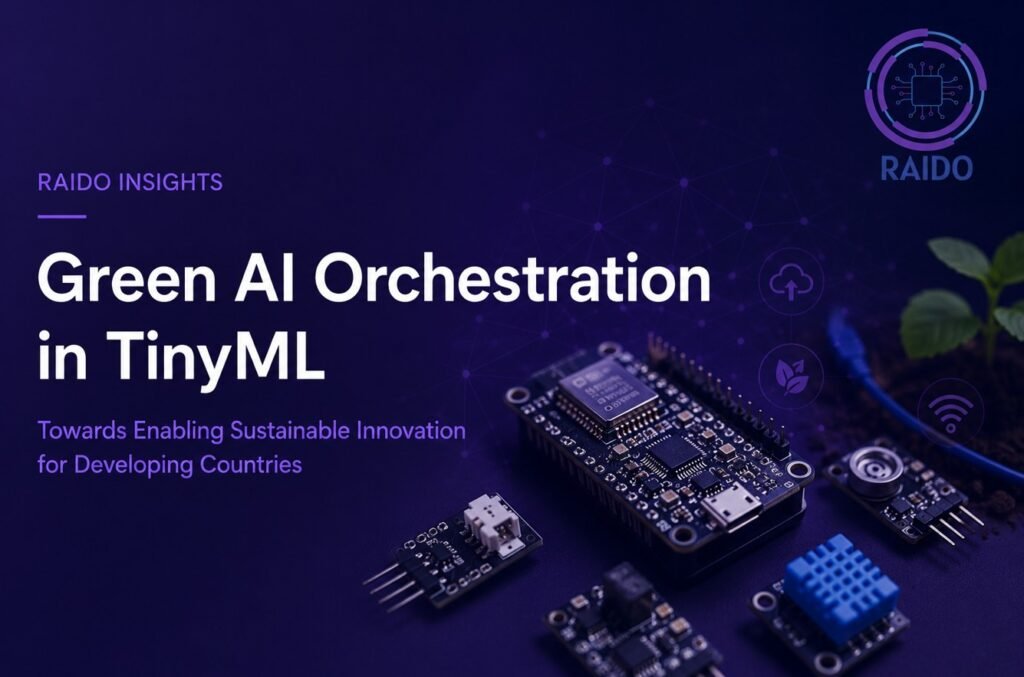
Artificial intelligence is often associated with massive data centers and energy-intensive computation. However, a new generation of lightweight and energy-efficient AI is emerging through TinyML — the deployment of machine learning models on ultra-low-power microcontrollers and embedded devices. Combined with AI orchestration, TinyML has the potential to democratize access to intelligent systems while supporting global sustainability goals.
RAIDO develops a framework for trustworthy and green AI that integrates data-efficient models, edge-to-cloud orchestration, explainable AI, and energy-aware deployment. Central to the project is a novel AI orchestrator designed to optimize tasks and processes while reducing the environmental footprint of AI systems during both development and deployment.
The recent IEEE work on Green AI orchestration for TinyML introduces the concept of “frugal intelligence,” where AI systems operate efficiently across distributed edge devices with minimal energy and infrastructure requirements. Instead of relying exclusively on centralized cloud computing, TinyML allows devices to process data locally, reducing latency, bandwidth usage, and operational costs. This approach is particularly important for regions with unstable connectivity or limited computational infrastructure.
AI orchestration plays a crucial role in this ecosystem. It coordinates how AI models, sensors, and computational resources interact across edge and cloud environments. Through orchestration, workloads can dynamically shift depending on energy availability, hardware capacity, or application priorities. This creates a more adaptive and environmentally sustainable AI infrastructure capable of supporting real-time decision-making in highly distributed environments.
The implications for sustainable development are substantial. Research on AI and sustainability demonstrates that AI-driven IoT systems can directly support the United Nations Sustainable Development Goals (SDGs), especially in areas such as agriculture, healthcare, climate resilience, and clean energy. TinyML orchestration makes these innovations more accessible because it lowers both hardware and operational costs.

For example, farmers in remote regions can deploy solar-powered TinyML sensors to monitor irrigation and soil conditions without continuous internet access. Health workers can use portable diagnostic devices operating entirely offline. Environmental agencies can create distributed sensor networks for flood prediction, wildfire detection, and biodiversity monitoring using low-cost microcontrollers coordinated through AI orchestration.
Importantly, Green AI orchestration also addresses a growing global concern: the environmental cost of AI itself. By reducing computational waste and enabling energy-aware deployment strategies, projects such as RAIDO demonstrate how trustworthy, human-centric, and sustainable AI infrastructures can be built for both advanced and developing economies. In this sense, TinyML is not merely a technical optimization — it represents a pathway toward more equitable and environmentally responsible digital transformation.
We use the opportunity to share a call for papers on these topics for the Journal of AI for Sustainable Development https://www.jaisd.org/call-for-papers-special-collection-on-edge-ai-for-development/
Read more about the engagement of RAIDO in TinyML and responsible participatory science research at:
Find us on Social Media